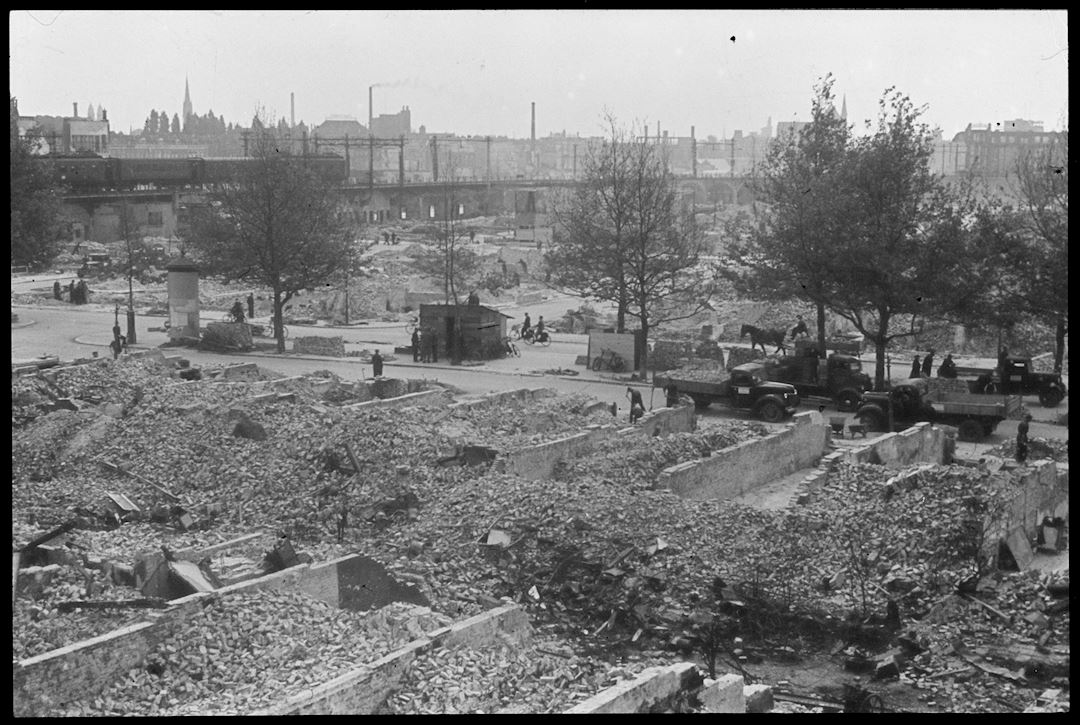
Bombing of Rotterdam
Transcript
A shocking sight, these ruins of Rotterdam after the bombardments on 14 May 1940 – the day of the Dutch capitulation. The houses on Zomerhofstraat have been swept away and people are searching through the rubble. On the horizon, a little left of centre, you can just see the silhouette of the Heineken brewery with smoke still coming from its tall chimney.
The second world war was a difficult time for Heineken Rotterdam. The brewery was allowed to continue operations on the condition that it supplied beer to the German army. But raw materials became harder to come by and cars and lorries were confiscated. And so the quality of the beer deteriorated and supplies became even harder. Even the director couldn’t come to work by car and instead was picked up every morning by his chauffeur on a tandem bike.
The war years were a fearful time for the employees as well, because the brewery was secretly sheltering colleagues who had been drafted to work in Nazi Germany. An illegal switchboard had been set up to connect resistance groups and the bowling alley in the basement served as a shooting range for gun practice.
At the end of the war, this Heineken office building became the headquarters of the resistance. Under the pretence of saving on electricity and heating, the entire second floor was cleared out. But in reality, the resistance headquarters was set up there and all the while, one floor down, Nazis walked in and out.